
Margate Sandy Soil and Your Concrete Foundation: What to Know
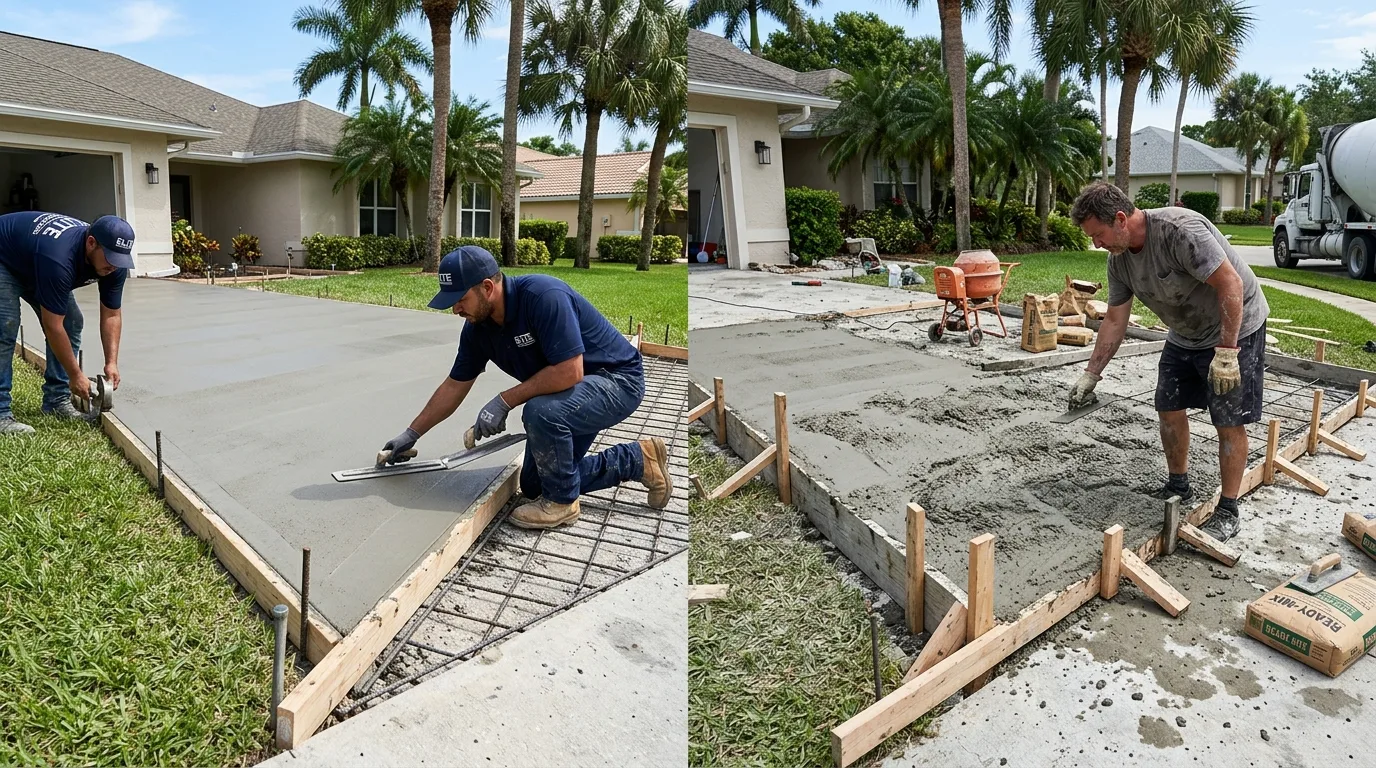
Most homeowners in Margate never think about what’s underneath their concrete until a crack shows up — and then they want to know why. The answer usually starts with soil: Margate’s Plantation series sandy soils over oolitic limestone bedrock behave very differently from the clay and loam soils in other parts of the country, and understanding those differences explains most of the concrete problems homeowners in Coral Bay, Margate Gardens, and Holiday Springs encounter. In this post, we cover how Margate’s soil profile affects concrete, what proper base preparation prevents, and when soil conditions require extra steps before a concrete slab goes down.
Concrete Foundation Work in Margate — Free Estimate
We assess soil and drainage conditions before any Broward County concrete project.
Why Margate’s Soil Is Different from Most of the Country
Margate sits on Broward County’s coastal lowlands, where the dominant soil series is the Plantation series — deep, poorly graded sandy soils with high permeability. Below that sandy layer, the substrate transitions to oolitic limestone bedrock typical of South Florida’s coastal geology. This soil profile has several important implications for concrete:
Sandy soil compacts unevenly under load. Unlike clay soils that compress consistently or rocky soils that barely compress at all, sandy soil redistributes under weight in unpredictable ways. A vehicle repeatedly driving over the same path compacts the soil differently under tire tracks than between them, gradually creating differential settlement in driveways and slabs poured directly on inadequately prepared sandy ground.
Sandy soil also has very low cohesion — it doesn’t hold together under lateral pressure the way clay does. This matters for slab edges and the perimeter of patios, where adjacent uncompacted soil can erode away from the slab edge during heavy rain, leaving unsupported overhang that eventually breaks off.
The High Seasonal Water Table Problem in Broward County
Broward County’s high seasonal water table (SHWT) is the most significant soil-related factor for concrete in Margate. During the wet season (May–October), heavy rainfall raises the water table significantly — in some parts of Margate, the water table is within 12–24 inches of the surface at peak wet season. Saturated sandy soil loses nearly all its bearing capacity, turning from a stable sub-base into something closer to wet sand.
Concrete slabs poured on sandy soil without adequate gravel base depth effectively float during high water table periods. Vehicle loads that the slab easily handles in the dry season stress it beyond capacity when the saturated sandy ground beneath it has lost its load-bearing support. This cycle — stable dry season, stressed wet season, repeat — is what gradually cracks driveways in Oriole Gardens and Fair Gate neighborhoods that were installed without the proper base preparation Broward County’s soil demands.
Is Your Margate Concrete at Risk? Get a Free Assessment
We evaluate soil and drainage conditions as part of every free estimate for Broward County projects.
What Proper Base Preparation Does for Margate Concrete
The solution to Margate’s sandy soil challenges is not exotic — it’s base preparation executed to the correct depth and material spec. For concrete driveways and slabs in Broward County:
Minimum 4-inch compacted gravel base: Washed stone or crushed limestone gravel compacted to a consistent density provides load distribution across the sandy sub-base. The gravel layer’s angular particles interlock and resist the lateral movement that loose sandy soil is prone to.
6-inch base depth for high-load applications: Driveways that regularly support heavy vehicles (RVs, work trucks, heavy SUVs) benefit from a 6-inch compacted base, particularly in Margate’s wetter neighborhoods near the Stranahan River waterfront in Fair Gate.
Drainage slope away from structures: The entire gravel base and finished concrete surface must slope away from the home’s foundation — minimum 1/8 inch per foot, ideally 1/4 inch per foot. This prevents the water accumulation that saturates the sub-base and causes the wet-season bearing capacity loss described above.
Geotextile fabric: In areas with particularly loose or silty soil, geotextile fabric placed between the existing soil and gravel base prevents soil migration up into the gravel layer over time — maintaining the base’s drainage performance through Broward County’s annual wet-dry cycles.
Practical Uses: Soil Knowledge in Real Margate Projects
Driveways near trees: Sandy soil around tree roots in Margate shifts significantly as roots grow and seasonal water table fluctuations occur. A concrete driveway close to established trees should include root barriers, deeper base work near the tree zone, and a joint design that allows for slight movement without full slab fracture.
Slabs near the water table high zone: Properties in low-lying Margate areas — particularly near drainage canals and the Stranahan River — benefit from raising the finished concrete grade by 1–2 inches above grade rather than excavating down. Pouring higher reduces the likelihood that the bottom of the gravel base contacts the saturated zone during Broward County’s peak wet season.
Foundation work in expansive soil pockets: While Margate’s dominant soil is sandy, there are pockets of expansive clay in Broward County’s subsurface. These are less common near the coast but do occur. Expansive clay swells when wet and shrinks when dry — the opposite behavior from sandy soil — and requires different remediation approaches. A soil assessment before foundation work in Margate is the safest approach.
Pool deck areas: Pool decks in Margate sit over soil that’s both saturated from irrigation and pool splash and subjected to repeated barefoot traffic loads. Adequate base depth and drainage design under pool decks reduces the likelihood of the joint cracking and section settling that makes Margate pool decks look aged within 10 years.
How Soil Conditions Affect Concrete Cost in Margate
Proper soil preparation adds cost to a concrete project — typically $1–$3 per square foot above the base concrete price. But in Margate’s environment, that preparation cost is one of the best investments in the long-term performance of any concrete project. A driveway installed with 2 inches of base prep instead of the required 4–6 inches will show visible cracking within 2–5 years. Repairing or replacing that driveway costs far more than the base prep would have.
Margate Concrete Pros includes proper Broward County base preparation in every project estimate. When you see a significantly lower bid from another contractor for the same square footage, ask specifically about base depth and material — that’s almost always where the cost difference hides.
Frequently Asked Questions
Does every Margate concrete project need a gravel base?
Yes — every concrete driveway, patio, slab, and pool deck in Margate should have a compacted gravel base of at least 4 inches. Skipping or shortening the base is the most common cause of premature concrete failure in Broward County’s soil conditions.
Can you pour concrete over existing concrete in Margate?
Bonded overlays (resurfacing) over existing structurally sound concrete work well in Margate. However, pouring a new 4-inch slab over an existing 2-inch deteriorated slab is not appropriate — the base slab must be removed and proper base prep installed. We assess existing slabs during every free estimate to determine whether overlay or replacement is the right approach.
How does Margate’s limestone bedrock affect concrete foundations?
Oolitic limestone bedrock at depth actually provides good long-term bearing capacity for foundations and deep slabs. The challenge in Margate is reaching that bedrock through the variable sandy soil layer above it — some areas have deep sandy profiles, others have limestone close to the surface. Foundation work in Margate should include soil borings or at minimum a visual assessment of excavated material before poring.
Margate Concrete Built for Broward County Soil
Call Margate Concrete Pros at (888) 376-0955 — every estimate includes a soil and drainage assessment.
Related: