
Concrete vs Asphalt Driveways: What's Best for Florida Weather?
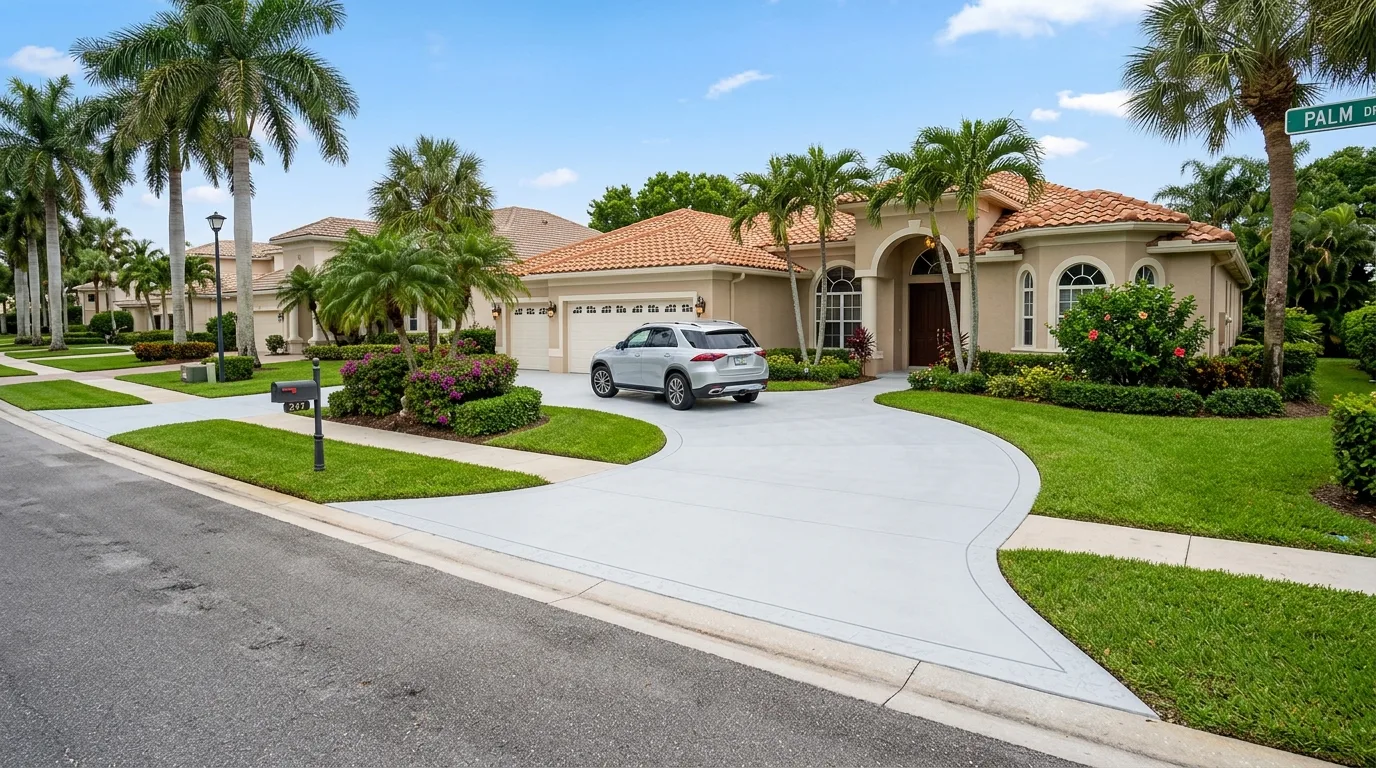
If you’re replacing a driveway in Margate and trying to decide between concrete and asphalt, the answer in South Florida is different from what you’d get for a home in Ohio or Minnesota. The freeze-thaw cycle that makes asphalt maintenance manageable in northern climates simply doesn’t exist in Broward County — and that changes the long-term math significantly. Here’s the honest comparison for Margate homeowners.
Concrete Driveway Estimates in Margate — Free & Fast
We quote concrete driveways throughout Broward County. Call (888) 376-0955.
How Florida’s Climate Changes the Concrete vs. Asphalt Equation
In northern states, asphalt’s main appeal is its ability to flex during freeze-thaw cycles without cracking the way concrete does. Florida has no freeze-thaw cycle — Margate’s temperatures rarely drop below 45°F, and the ground never freezes. This removes asphalt’s primary structural advantage in cold climates.
What Florida does have is intense UV radiation, sustained high temperatures, and humidity. Both of these conditions affect asphalt more severely than concrete. Understanding this difference is the foundation of making the right driveway choice for a Margate home.
Types of Surfaces: What You’re Actually Comparing
Concrete driveways in Margate:
- 3,000–4,000 PSI poured concrete with compacted gravel base
- Minimum 4-inch thickness per Broward County code
- Wire mesh or rebar reinforcement
- Expansion joints every 8–10 feet to manage thermal movement
- Requires sealing every 2–3 years for UV protection
- Can receive stamped, colored, or exposed aggregate finishes
Asphalt driveways in Margate:
- Hot-mix asphalt (HMA) compacted over aggregate base
- Typically 2–3 inch asphalt layer over 4-inch aggregate base for residential
- Flexible surface that moves with temperature changes
- Requires sealcoating every 3–5 years
- Resurfacing typically needed every 15–20 years
- Limited finish options (black, occasional gray coatings)
How UV and Heat Affect Each Surface in Margate
Asphalt in South Florida: Asphalt binders soften in sustained heat. Margate’s summer temperatures regularly hit 90–95°F, and asphalt driveway surfaces in full sun can reach 140–180°F — temperatures that cause the binder to soften and track (leave tire marks), indent under vehicle weight at rest, and accelerate UV oxidation that makes asphalt brittle and prone to cracking within 5–10 years without frequent maintenance.
Concrete in South Florida: Concrete is rigid and not affected by softening in heat. It does expand thermally (hence the expansion joints), but the material properties don’t change. UV degrades the surface cement paste on unsealed concrete, causing spalling — but this is managed effectively with 2–3 year resealing cycles. Concrete also becomes much hotter to the touch in sun than asphalt (though asphalt reaches higher temperatures beneath the surface).
Margate Concrete Driveway Pros — Get Your Quote
Free estimate with specs included. Serving all of Broward County.
Practical Uses: Where Each Surface Makes Sense in Margate
Concrete is better for:
- Residential driveways in Margate: Longer lifespan (30–40 years vs. 15–20 for asphalt), lower total lifetime cost for residential driveways, more finish options, higher property value contribution.
- Pool decks and patios: Heat resistance and decorative options make concrete clearly superior for pool-adjacent surfaces in South Florida.
- High-traffic areas: Concrete handles heavy vehicle loads (RVs, work trucks) without the indentation risk that affects asphalt in Florida’s heat.
- Decorative applications: Stamped concrete, colored concrete, and exposed aggregate all require the rigidity and finish-ability of concrete — there’s no stamped asphalt equivalent.
Asphalt may be considered for:
- Very large driveways or parking areas where initial cost is the priority: Asphalt installs at $3–$5/sqft vs. $6–$12/sqft for concrete — the lower upfront cost is the primary asphalt argument in Broward County.
- Commercial parking lots with budget constraints: Large commercial areas where per-square-foot cost matters more than long-term maintenance savings sometimes choose asphalt for initial installation.
Cost Comparison for Margate Driveways
| Concrete | Asphalt | |
|---|---|---|
| Installation (600 sqft) | $3,600–$7,200 | $1,800–$3,000 |
| Sealing/maintenance cycle | Every 2–3 years, $200–$600 | Every 3–5 years, $300–$600 |
| Expected lifespan (Margate) | 30–40 years | 15–20 years |
| Resurfacing | Optional after 25+ years | Required at 15–20 years ($1,500–$3,500) |
| Replacement | After 35–40 years | After 20–25 years |
Over a 40-year period in Broward County, a concrete driveway typically costs less in total (installation + maintenance + one replacement equivalent) than cycling through two asphalt driveways with all their maintenance requirements. The break-even for concrete vs. asphalt in South Florida is typically 12–15 years.
What Adds to Long-Term Cost in Margate
Asphalt’s maintenance demands are higher frequency in South Florida than northern guides suggest. Because UV and heat degrade asphalt binder faster in Broward County’s climate, sealcoating every 2–3 years (not 5) is more realistic for maintaining an asphalt driveway in Margate. This compresses the cost advantage over concrete faster than homeowners expect.
Concrete’s main long-term cost variable in Margate is drainage. Poor drainage leads to sub-base erosion under Broward County’s wet season water table rises, which causes cracking. A concrete driveway installed with proper drainage design in Margate requires very little intervention over 35–40 years. One that drains poorly may need significant repair within 10–15 years.
Frequently Asked Questions
Does asphalt crack more than concrete in Margate?
Not necessarily from physical cracking — both surfaces crack over time in Broward County’s soil conditions. Asphalt tends to show more surface degradation (raveling, pot holes) in South Florida’s UV and heat. Concrete cracks more cleanly but can develop sub-base cracks that require repair. With proper installation, concrete cracking in Margate is generally less frequent and less costly to address than asphalt deterioration.
Can I switch from asphalt to concrete in Margate?
Yes — this is one of the most common driveway replacement projects in Broward County. Old asphalt is excavated (typically 2–3 inch removal), the aggregate base is assessed and deepened if needed to the 4–6 inch spec required for concrete, and new concrete is poured. The permit process for a new concrete driveway applies to this replacement. We handle the full project including asphalt removal.
Will a concrete driveway add more value than asphalt in Margate?
Generally yes. Concrete driveways are perceived as higher quality in the South Florida real estate market, and their decorative finish options (stamped, colored, exposed aggregate) contribute more to curb appeal and appraisal value than asphalt’s uniform black surface. In Margate’s competitive market, especially in higher-value neighborhoods like Coral Bay and Holiday Springs, concrete is the expected material for driveways in homes above the median price range.
Upgrade to Concrete in Margate — Free Estimate
From asphalt replacement to new concrete driveways, we handle the full project in Broward County. (888) 376-0955.
Related: